Dog training and technology
AI in Dog Training: What It Can Do, What It Cannot Do, and Where It Is Going
Artificial intelligence can help us look more carefully at dog-training video. It can locate a dog and handler, follow visible movement, mark a sequence of events and measure some aspects of timing. Used well, that can make practice between professional sessions more deliberate and easier to review.
What it cannot do is read a dog’s mind, establish why a behaviour occurred, diagnose pain or a behavioural disorder, or decide whether a situation is safe. Those limits matter more than any impressive demonstration.
In brief: The most credible use of AI in dog training is not autonomous training. It is structured observation: helping owners and professionals review what was visible and audible in a recording, measure selected mechanics, and decide what deserves closer human attention.
Key takeaways
- AI can assist with observation, event logging and measurement when the recording and task are suitable.
- A bounding box shows where a system thinks an object is; it does not reveal intention, emotion or learning.
- Detection, tracking, behaviour recognition, training-event identification, measurement and interpretation are separate capabilities.
- Reliable feedback needs defined criteria, traceable evidence, uncertainty and a clear route to “not enough information”.
- Trainers, clinical behaviourists, veterinary professionals and rehabilitation practitioners remain responsible for work within their respective scopes.
Contents
- What “AI in dog training” means
- Seeing is not the same as understanding
- What bounding boxes can—and cannot—show
- From boxes to movement
- From movement to training events
- Why timing is a useful, bounded target
- The Cue–Mark Latency Index (CMLI)
- What can be measured from a training video
- What makes feedback trustworthy
- The risk of confident invention
- How this can genuinely help owners
- Where professionals fit
- What a clip cannot tell us
- Where the field is likely to go
- Frequently asked questions
What “AI in dog training” means
AI-assisted dog training is the use of computer vision, machine learning and language-based systems to observe recorded practice, identify visible or audible events, measure selected relationships in timing and movement, and support feedback between sessions with qualified professionals.
That definition is deliberately narrow. It concerns video analysis, observable training mechanics and feedback. It does not include wearables, tracking devices, automated feeders, collars or robotics.
The component technologies do different jobs:
- Computer vision can locate and follow visible subjects or estimate the positions of body points.
- Machine learning can classify examples according to patterns learned from labelled data.
- Language systems can turn structured observations into readable explanations or questions.
None of these components supplies context automatically. A video model may locate a dog perfectly while missing the behaviour that matters. A classifier may recognise a movement seen in its training data while failing on a different breed, camera angle or room. A fluent explanation may sound plausible even when the underlying recording does not support it.
My perspective combines more than 20 years working with data, business intelligence and analytics with around four years exploring dog training, including direct work with video and structured observations. That experience makes me optimistic about measurement and cautious about interpretation. A system should extend careful observation, not borrow authority from technical language.
Seeing is not the same as understanding
AI capability is often discussed as if it were a single ladder that a system climbs automatically. It is better understood as six distinct problems:
- Detection: Is there a dog, person or object in this frame, and roughly where is it?
- Tracking: Is this the same dog, person or object across successive frames?
- Behaviour recognition: Does a visible movement match a defined class such as sitting, lying down or turning?
- Training-event identification: Which moment was the cue, the completed behaviour, the marker and the delivery of reinforcement?
- Measurement: What was the time interval, duration, distance, repetition count or spatial relationship?
- Interpretation: What, if anything, does that observation mean for this dog, this handler and this training plan?
Detection is location. Tracking is continuity. Recognition is classification. Event identification is sequence. Measurement is quantity. Interpretation is judgement. Each step requires new evidence; none inherits certainty merely because the step before it worked.
This distinction prevents a common error. A reliable box around a dog is evidence that the detector found a dog-like object. It is not evidence that the system understands the exercise. Likewise, recognising a sit does not establish whether the dog responded to a verbal cue, followed a hand movement, anticipated a routine or sat for an unrelated reason.
Research systems demonstrate why the distinctions matter. Markerless pose-estimation methods can estimate user-defined body points, and multi-animal systems can maintain identities in controlled recordings. Their authors nevertheless treat occlusion, identity swaps, viewpoint and annotation quality as technical problems, not solved details.[2] [3] Dog-specific datasets add large variation in body shape, coat and pose, while synthetic-to-real transfer remains difficult.[4] [5]
What bounding boxes can—and cannot—show
An object detector processes an image and predicts candidate locations and classes. In the original YOLO approach, a neural network predicted bounding boxes and class probabilities from the whole image in a single evaluation.[1] Modern implementations vary, but the visible output is familiar: a rectangle, a label such as “dog” or “person”, and sometimes a confidence score.
The rectangle is useful. It can:
- indicate whether the dog and handler are visible;
- provide a position that can be followed between frames;
- help calculate approximate distance or orientation in the image;
- flag when a subject leaves the frame or becomes obscured.
But the box contains no intention. It does not show that the dog understood a cue, enjoyed the exercise, felt worried, was in pain or was learning successfully. A “person” box does not tell us whether a subtle hand movement became an unintended prompt. Even a high confidence score describes the model’s classification, not the truth of a behavioural explanation.
A bounding-box image should therefore be labelled as an illustration of object location, not as proof of behavioural understanding.
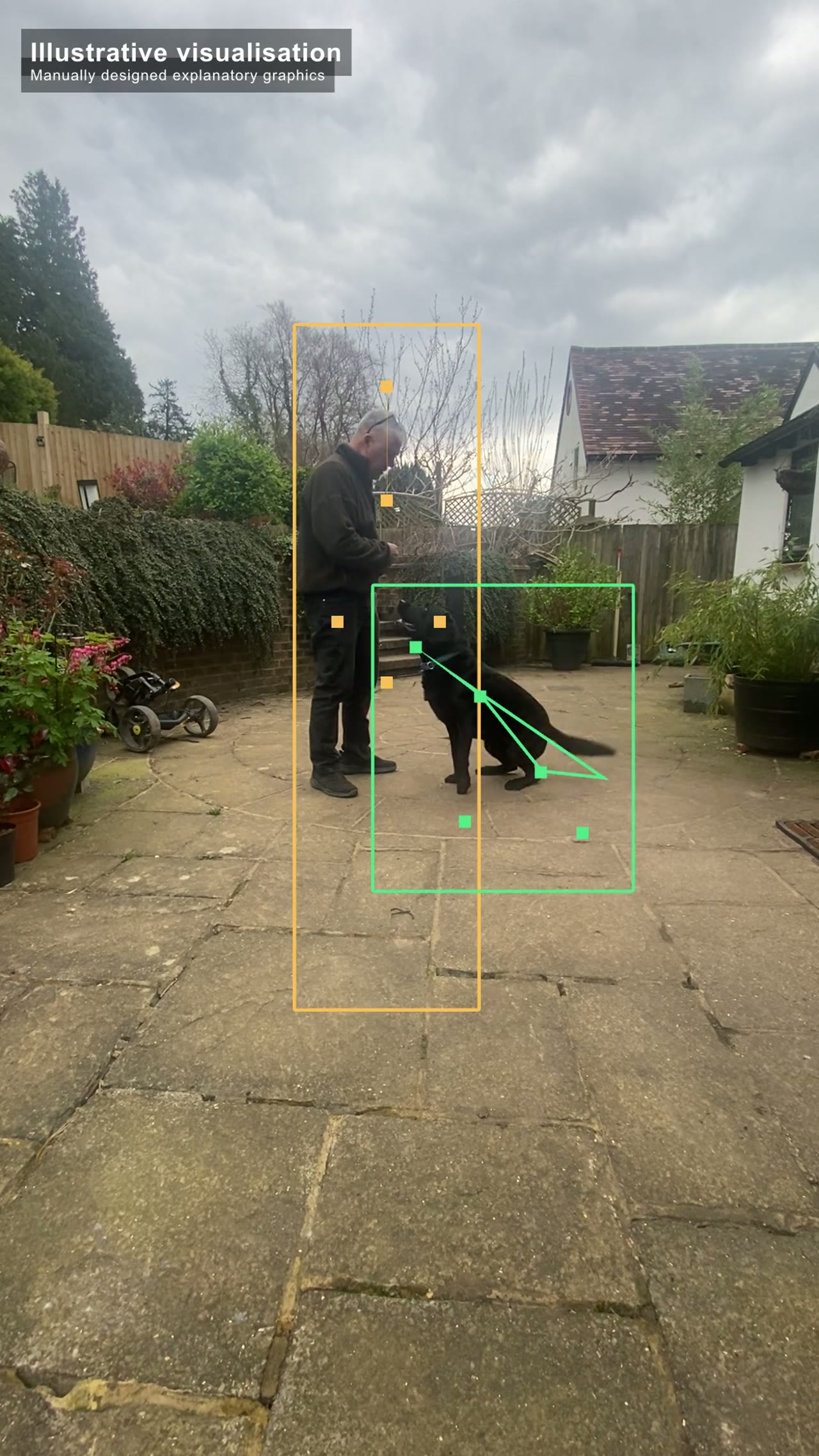
Illustrative visualisation Manually designed explanatory graphics based on owned footage. They show broad visible position and movement only; they are not automated analysis or measurement and support, rather than replace, professional training judgement.
This later section shows another short cycle: the dog moves back towards the handler, pauses, and lowers into position. The manually placed visual guides make the broad movement easier to follow. Repeated examples can be useful when looking at visible consistency across a session, but a qualified trainer would still consider the full video and context before drawing any conclusion.
From boxes to movement
Tracking links detections through time. Pose estimation goes further by predicting points such as the nose, ears, shoulders, paws or tail base. From those points, a system may estimate a change in posture, direction or speed.
That sounds straightforward until the recording contains a long coat, a curled tail, a dark dog on a dark floor, a handler blocking the camera or a rapid turn. Dog shape varies greatly between breeds, and a two-dimensional image collapses depth. In one of the larger dog-pose research efforts, StanfordExtra, researchers had to annotate thousands of dog instances to address variation in pose and appearance.[4] More recent work using synthetic dog video has expanded temporal data, but its authors explicitly report a domain gap between synthetic and real images and the continuing cost and fallibility of real-world annotation.[5]
Pose estimates can be valuable evidence. They are not a clinical gait assessment, a body-language verdict or a diagnosis. They are coordinates with uncertainty.
From movement to training events
Training analysis requires events, not just objects. Consider a simple sequence:
cue → behaviour → marker → delivery of reinforcement
Each label needs an operational definition. Does the cue begin when a word becomes audible, when a hand starts moving, or when both occur? Is the behaviour complete when the dog’s movement begins, when the position is achieved or when a defined criterion is held? Is reinforcement “delivered” when the handler reaches for food, presents it or the dog receives it?
Different definitions produce different measurements. They may all be legitimate for different questions, but they cannot be mixed silently.
Machine-learning research can classify researcher-defined animal behaviours from video, particularly when examples are labelled and conditions are bounded.[6] [7] A 2023 study used automated dog-and-person trajectories from a controlled behavioural test and reported 78% accuracy in predicting expert scores.[8] That is useful evidence of a specific research pipeline—not proof that a consumer system can understand an ordinary training session.
The study involved 53 dogs, a standardised test, expert scoring and a fixed camera arrangement. Three videos failed a tracking-quality criterion, leaving 47 for trajectory processing; the cluster-to-expert comparison was shown for 46 dogs, and rare negative-score cases were excluded from the study. The authors described the work as exploratory and called for larger samples and further validation.[8] A later review of automation in canine science found that much published work still relies on object tracking and hand-selected features, with more advanced localisation and activity recognition not yet fully explored.[9]
Laboratory recognition is a capability claim about a defined dataset. Coaching is a much broader claim about measurement, context, individual dogs and consequences.
Why timing is a useful, bounded target
Timing is one of the most promising subjects for video review because events can sometimes be anchored to visible frames or an audio waveform. A consistent filming set-up makes those comparisons more useful. A reviewer can ask:
- How long passed between the cue and the start of the behaviour?
- Did a marker occur before, at or after a defined completion point?
- Did reaching for food begin before the marker?
- How long passed between the marker and access to reinforcement?
These questions concern observable sequence and elapsed time. They do not require the system to infer emotion.
Timing also matters in learning, but evidence should not be turned into a universal rule. In a small 2009 study, ten dogs performed already learned sit and down responses while delays between owner actions were varied; longer delays reduced correct responses under those particular conditions.[10] A later systematic review found that conditioned reinforcement can be effective, while also noting the small evidence base, inconsistent reporting and uncertainty about the effects of delay.[11]
The responsible conclusion is that temporal relationships deserve attention. It is not that every dog, behaviour and reinforcer shares a single ideal number of milliseconds. Frame rate, audio synchronisation and event definitions also limit the precision of any measurement.
The Cue–Mark Latency Index (CMLI)
To make handler timing easier to describe consistently, I propose the Cue–Mark Latency Index (CMLI): cue-to-marker latency corrected for the time the dog took to perform the defined target behaviour.
For one assessable repetition:
CMLI = (marker onset − cue onset) − (criterion reached − cue onset) = marker onset − criterion reached
In plain language, CMLI isolates the marker's position relative to the observable training criterion instead of treating the dog's response time as handler delay. A negative value means the marker preceded the defined criterion, zero means the two events aligned at the recording's available precision, and a positive value means the marker followed the criterion.
CMLI is a descriptive measurement, not a diagnosis or a universal pass score. A session report should show the median signed CMLI, the median absolute CMLI, the spread between repetitions, the number of assessable attempts and the recording precision. Reporting only an average—or converting the result into an unexplained score out of 100—would hide useful variation.
| Measure | Operational definition | What it can show | What it cannot show alone |
|---|---|---|---|
| Raw cue-to-mark latency | Marker onset minus cue onset | Elapsed time across the whole prompted response | Handler accuracy, because it includes the dog's response time |
| Cue–Mark Latency Index (CMLI) | Marker onset minus the defined behaviour criterion | Whether the marker preceded, aligned with or followed that criterion | Why the timing occurred or whether the criterion was appropriate |
| Marker-to-reward-movement separation | Reward-predictive hand movement onset minus marker end | Whether food-hand movement began before, during or after the marker | When the dog received the reinforcer or what the dog learned |
| Marker-to-reward delivery | Dog's first access to the reinforcer minus marker end | The observable delay to primary reinforcement | A universal ideal window across tasks, dogs and reinforcers |
| Assessability rate | Assessable repetitions divided by attempted repetitions | How often the view and sound supported the requested measurement | Whether an unobserved event did or did not occur |
Illustrative worked example — hypothetical values only
The invented examples below show how the measures would be recorded and read. The sample-handler labels do not refer to real people, clips, qualifications or performance. These values are not study data, a benchmark, a pass/fail rule or a universal timing threshold.
| Placeholder label | Cue → criterion | Cue → marker | CMLI | Marker end → reward movement | Marker end → reward access | Descriptive reading |
|---|---|---|---|---|---|---|
| Sample handler A | 800 ms | 800 ms | 0 ms | +900 ms | +1,800 ms | Marker and criterion align at the stated precision; reward movement starts after the marker ends. |
| Sample handler B | 1,200 ms | 1,050 ms | −150 ms | −100 ms | +700 ms | Marker precedes the defined criterion; reward-predictive movement begins before the marker ends. |
| Sample handler C | 650 ms | 1,000 ms | +350 ms | +450 ms | +1,200 ms | Marker follows the defined criterion; reward movement and access occur later in the sequence. |
| Sample handler D | Not visible | 980 ms | Not assessable | +600 ms | Not visible | The obscured criterion prevents CMLI calculation; only the visible sequence elements are reported. |
The distinction between reward movement and reward delivery is deliberate. A hand entering a pouch is a handler-mechanics event; the dog receiving food is a reinforcement event. Combining them would make results from different camera angles and training tasks difficult to compare.
The word “index” does not make CMLI a validated standard. It is an openly defined measurement proposal that can be tested, criticised and revised. A credible Handler Mechanics Benchmark would publish observed distributions rather than invented “ideal” thresholds: participant and repetition counts, task definitions, camera and audio conditions, median and interquartile range, uncertainty intervals, unassessable rates, human-annotator agreement and model error against independently reviewed timestamps. Until those data have been collected under an agreed protocol and consent covers aggregate publication, example figures should not be presented as findings.
What can be measured from a training video
When the camera view, sound and criteria are adequate, video analysis may support review of selected visible timing, movement, interaction and recording-quality patterns. It can help organise what was observable in a clip and make particular moments easier for an owner and qualified professional to discuss.
That is a deliberately limited claim. Video does not reveal internal states, diagnose pain or behaviour, or independently determine whether training was good or effective. Any review remains dependent on the recording, the defined question and appropriate human judgement.
That limitation is important. A hand can disappear behind a body. A word can be masked by noise. Food can be prepared out of frame. A camera can move. The system should distinguish “not observed” from “did not happen”.
Nor do the measurements explain themselves. A longer cue-to-movement interval may reflect an unclear cue, a distraction, the dog checking the environment, fatigue, sensory difficulty, discomfort or a recording error. Video supplies evidence for a conversation; it does not settle the cause.
What makes feedback trustworthy
Useful feedback needs more than a capable model. It needs a disciplined assessment process. One way to express that process is as a rubric: a set of defined, reviewable criteria for the particular task. The rubric should constrain what is reported, not disguise subjective judgement as a score. Reliable feedback also depends on clear enough evidence and appropriate context. A responsible system should acknowledge when footage, sound or circumstances are insufficient, distinguish observation from interpretation, and avoid presenting uncertainty as fact.
Those safeguards do not turn video analysis into diagnosis or an independent judgement about training quality. The significance of any observation depends on the individual dog and situation, so qualified trainers, behaviour professionals, vets and rehabilitation practitioners remain essential where their expertise is needed. Recordings should also be handled with appropriate consent, privacy and care.
The risk of confident invention
Language-based systems can make uncertain observations sound complete. Video systems have their own version of this problem: inferring an action that is absent, placing events in the wrong order or describing a transition that did not occur. A 2025 benchmark identified action, temporal-sequence and scene-transition hallucinations across video-language systems.[14]
In dog-training footage, plausible inventions might include:
- claiming that food was delivered when the hand and dog’s mouth were off camera;
- identifying a sit from the handler’s familiar movement rather than the dog’s obscured body;
- reporting a precise marker interval when audio and video were not synchronised;
- assigning “fear”, “stubbornness” or “excitement” to an ambiguous posture;
- assuming that an event outside the clip did not happen.
How this can genuinely help owners
Most training happens away from a professional. Memory is selective, and small mechanical changes can be difficult to notice while simultaneously watching the dog, managing reinforcement and thinking about the next repetition.
A carefully bounded video review can help an owner:
- identify which repetition to discuss with a trainer;
- compare practice against a plan agreed with a professional;
- notice a repeated cue, early food-hand movement or change in reward placement;
- see whether difficulty, duration or distraction changed too quickly;
- keep a consistent record between sessions;
- formulate a better question instead of relying on a general impression.
This is decision support, not an automated prescription. The best feedback often ends with a question: “This hand movement appeared before the verbal cue in four of five visible repetitions. Was the aim to transfer from the hand signal to the verbal cue?” That is more useful than pretending to know the trainer’s plan.
AI can also make professional time more efficient. A trainer may be able to review a short, well-indexed segment rather than search through a long recording. A veterinary professional may benefit from a clearly dated video of a change, while still relying on history and clinical examination.
Where professionals fit
The relevant professional depends on the question. Titles, legal scopes and qualification systems differ between countries, so owners should check recognised local registers and professional requirements.
Dog trainer
A suitably qualified trainer helps teach skills, shape the training environment and improve the handler’s mechanics. Video measurements can support that work, but the trainer decides how an observation fits the individual training plan. In the UK, the Animal Behaviour and Training Council describes trainer and instructor roles separately from clinical behaviour work.[17]
Clinical animal behaviourist or equivalent
A qualified behaviourist deals with complex or problematic behaviour using history, context and an individual assessment, commonly in collaboration with a vet. The ABTC places clinical animal behaviour work on veterinary referral, particularly where behaviour is problematic or dangerous.[17] Equivalent pathways and protected titles vary internationally.
Veterinary surgeon
A vet assesses medical contributors, including pain, illness, sensory change and neurological disease. Behavioural change can be a sign of pain, and pain assessment draws on clinical examination, owner history and behavioural observation rather than video alone.[15] [16] Only an appropriately licensed veterinary professional can diagnose and prescribe within local law.
Veterinary behaviourist
A veterinary behaviourist is a vet with advanced specialist training in behaviour. This role can integrate medical and behavioural diagnosis and, where appropriate, prescribe medication. North American guidance distinguishes veterinary behaviourists from non-veterinary behaviour consultants, while the European College recognises veterinary specialists who have completed advanced training and assessment.[18] [19]
Canine physiotherapist or rehabilitation practitioner
These professionals work with mobility, function, conditioning and recovery within the rules of their jurisdiction and, commonly, a veterinary-led plan. For example, UK guidance requires veterinary assessment and delegation for remedial musculoskeletal treatment.[20] Video can help document movement over time, but pose coordinates are not a physiotherapy assessment.
The roles overlap through collaboration, not substitution. A trainer should not diagnose pain; an AI system should not decide aggression risk; a video measurement should not overrule a clinical examination.
What a clip cannot tell us
A clip is a sample shaped by the camera, the person recording and the moment chosen. It may not show:
- what happened immediately before or after;
- the dog’s medical and behavioural history;
- prior learning or reinforcement;
- changes in sleep, appetite, mobility or medication;
- scent, sound or activity outside the frame;
- the handler’s intended criterion;
- whether the behaviour occurs in other contexts;
- the dog’s internal emotional state;
- the probability or severity of a future aggressive event.
People can also disagree about the same visible behaviour. Questionnaire and video studies have found limitations in owners’ recognition of stress and associations between observer characteristics and interpretations of dog behaviour.[12] [13] AI trained on human labels can reproduce the ambiguity or bias in those labels; it does not escape it.
Stop automated review and seek veterinary advice when behaviour changes suddenly or footage suggests pain, lameness, stiffness, collapse, neurological signs or other illness. Seek urgent veterinary care for an acute emergency. Concerns involving aggression, severe fear or panic, repetitive behaviour, serious welfare decline or risk to people or animals call for a vet and an appropriately qualified behaviour professional. Ordinary skill teaching without medical or safety concerns belongs with a suitably qualified trainer.
Where the field is likely to go
The following is a reasoned outlook, not a claim that these capabilities are already reliable in everyday products.
Better capture-quality checks
Systems are likely to become better at saying that the dog is obscured, the sound is unusable or the camera angle cannot answer the question. Refusing unsuitable input may improve reliability more than producing a more elaborate interpretation.
Stronger multimodal event records
Video, audio and user-supplied exercise criteria can be aligned into a reviewable sequence. The useful output will be an evidence record—timestamps, clips and uncertainty—not just a paragraph of advice.
Individual baselines
With appropriate consent and consistent recording, repeated observations may be compared with the same dog’s earlier sessions. An individual baseline is often more meaningful than a generic “normal”, but change detection still cannot establish its cause.
Professional review queues
Systems may help owners select the few segments that deserve attention and route questions to the right professional. This could make asynchronous coaching more focused while keeping judgement with a person who knows the case.
More demanding validation
Credible systems will need testing across breeds, body types, coat colours, ages, mobility differences, handlers, environments, cameras and training tasks. They will also need failure reporting: not only how often a classification is correct, but when the system abstains, whom it works less well for and what happens when it is wrong.
The direction worth pursuing is not a digital trainer that claims to know the dog. It is a more accountable observation tool that helps people see what the evidence supports and recognise when it is time to ask someone qualified.
Conclusion
AI can make parts of dog-training practice more observable. It can locate subjects, organise a recording, identify tightly defined events and measure selected timing or movement. Those capabilities may support owners between sessions and give professionals a clearer record to discuss.
The boundary is equally important. Boxes do not contain meaning. Measurements do not diagnose causes. Fluent feedback does not create missing context. The responsible role for AI is to support judgement with evidence, uncertainty and referral—not to replace the trainer, behaviourist, vet or rehabilitation professional whose expertise the situation requires.
Frequently asked questions
Can AI train my dog without a trainer?
No. AI can help review visible practice and organise measurements, but it cannot assess the whole dog, household, environment or training history. Use it as support for a plan developed with a suitably qualified professional.
Can AI understand my dog’s body language or emotions?
It may classify defined visible postures or movements under tested conditions. That is not the same as knowing an emotional state. Context, history, the full behavioural sequence and human expertise remain necessary.
Can AI diagnose pain, anxiety or aggression?
No. Video may document a change worth showing to a professional, but diagnosis and risk assessment require qualified clinical or behavioural judgement. Sudden change, possible pain or illness should be referred to a vet.
What can AI measure in a training video?
Depending on recording quality, it may measure event order, elapsed time, duration, repetition count, approximate position and visible handler movement. Every result depends on clear event definitions and adequate evidence.
Does a bounding box prove that AI understands the exercise?
No. A bounding box only locates an object the detector has classified, such as a dog or person. It does not reveal intention, emotion, comprehension or learning.
How good does the recording need to be?
The dog and relevant handler movements should remain visible, the camera should be stable, and important sounds should be clear. If the event is obscured, off camera or inaudible, a responsible system should say it cannot determine what happened.
Can AI identify the perfect reward or marker timing?
It can estimate intervals between defined visible or audible events, subject to frame rate and synchronisation. Research supports paying attention to timing, but it does not establish one universal ideal interval for every dog and task.
Who should review a serious behaviour concern?
Begin with a veterinary assessment when pain, illness or sudden change may be involved. Aggression, severe fear, panic or welfare concerns require an appropriately qualified behaviour professional working with the vet. Seek urgent veterinary care for an acute emergency.
How should I judge an AI training-analysis claim?
Ask what the system actually detected, how events were defined, whether results were validated on comparable footage, how uncertainty is shown and when it refuses to answer. Treat consumer coaching claims as unproven if the evidence only demonstrates behaviour recognition in controlled research.
About the author
Dean Laval has more than 20 years’ experience in data, business intelligence and analytics, alongside around four years exploring dog training. His work includes hands-on investigation of training video and structured observation, with a focus on what technology can measure responsibly and where professional judgement must lead.
Disclosure
The author is developing 4muddypawz, which explores structured video feedback for dog-training practice. No product was evaluated or promoted in this article. The scope and conclusions were set by published evidence, explicit safety boundaries and professional-role guidance; proprietary implementation details are intentionally excluded.
Last reviewed: 31 July 2026.
References
1. Redmon J, Divvala S, Girshick R, Farhadi A. “You Only Look Once: Unified, Real-Time Object Detection.” Proceedings of the IEEE Conference on Computer Vision and Pattern Recognition. 2016. CVF Open Access.
2. Mathis A, et al. “DeepLabCut: markerless pose estimation of user-defined body parts with deep learning.” Nature Neuroscience. 2018;21:1281–1289. https://doi.org/10.1038/s41593-018-0209-y.
3. Pereira TD, et al. “SLEAP: A deep learning system for multi-animal pose tracking.” Nature Methods. 2022;19:486–495. https://doi.org/10.1038/s41592-022-01426-1.
4. Biggs B, Boyne O, Charles J, Fitzgibbon A, Cipolla R. “Who Left the Dogs Out? 3D Animal Reconstruction with Expectation Maximization in the Loop.” European Conference on Computer Vision. 2020. https://arxiv.org/abs/2007.11110.
5. Shooter M, Malleson C, Hilton A. “SyDog-Video: A Synthetic Dog Video Dataset for Temporal Pose Estimation.” International Journal of Computer Vision. 2024;132(6):1986–2002. https://doi.org/10.1007/s11263-023-01946-z.
6. Valletta JJ, Torney C, Kings M, Thornton A, Madden J. “Applications of machine learning in animal behaviour studies.” Animal Behaviour. 2017;124:203–220. https://doi.org/10.1016/j.anbehav.2016.12.005.
7. Bohnslav JP, et al. “DeepEthogram, a machine learning pipeline for supervised behavior classification from raw pixels.” eLife. 2021;10:e63377. https://doi.org/10.7554/eLife.63377.
8. Farhat N, et al. “Digitally-enhanced dog behavioral testing.” Scientific Reports. 2023;13:21252. https://doi.org/10.1038/s41598-023-48423-8.
9. Farhat N, van der Linden D, Zamansky A, Assif T. “Automation in canine science: enhancing human capabilities and overcoming adoption barriers.” Frontiers in Veterinary Science. 2024;11:1394620. https://doi.org/10.3389/fvets.2024.1394620.
10. Yamamoto M, Kikusui T, Ohta M. “Influence of delayed timing of owners’ actions on the behaviors of their dogs, Canis familiaris.” Journal of Veterinary Behavior. 2009;4(1):11–18. https://doi.org/10.1016/j.jveb.2008.08.006.
11. Pfaller-Sadovsky N, Hurtado-Parrado C, Cardillo D, Medina LG, Friedman SG. “What’s in a Click? The Efficacy of Conditioned Reinforcement in Applied Animal Training: A Systematic Review and Meta-Analysis.” Animals. 2020;10(10):1757. https://doi.org/10.3390/ani10101757.
12. Mariti C, Gazzano A, Moore JL, Baragli P, Chelli L, Sighieri C. “Perception of dogs’ stress by their owners.” Journal of Veterinary Behavior. 2012;7(4):213–219. https://doi.org/10.1016/j.jveb.2011.09.004.
13. Meyer I, Forkman B, Paul ES. “Factors Affecting the Human Interpretation of Dog Behavior.” Anthrozoös. 2014;27(1):127–140. https://doi.org/10.2752/175303714X13837396326576.
14. Li X, Im D-J, Fazli P. “VidHalluc: Evaluating Temporal Hallucinations in Multimodal Large Language Models for Video Understanding.” Proceedings of the IEEE/CVF Conference on Computer Vision and Pattern Recognition. 2025. CVF Open Access.
15. Monteiro BP, et al. “2022 WSAVA guidelines for the recognition, assessment and treatment of pain.” Journal of Small Animal Practice. 2023;64(4):177–254. WSAVA pain guidelines.
16. Gruen ME, et al. “2022 AAHA Pain Management Guidelines for Dogs and Cats.” Journal of the American Animal Hospital Association. 2022;58(2):55–76. AAHA guideline PDF.
17. Animal Behaviour and Training Council. “Types of Practitioners.” ABTC (accessed 29 July 2026).
18. American Veterinary Society of Animal Behavior. “Directory: Who can help with animal behaviour?” AVSAB (accessed 29 July 2026).
19. European College of Animal Welfare and Behavioural Medicine. “About us.” ECAWBM (accessed 29 July 2026).
20. Royal College of Veterinary Surgeons. “Treatment of animals by unqualified persons.” RCVS supporting guidance (accessed 29 July 2026).